Can you share how is the system / Postgres configured? It's a good
practice to provide all the information others might need to reproduce
your results.
All defaults form initdb this time.
In particular, what is shared_buffers set to? Are you still using
io_method=worker? With how many io workers?
The command line argument --workers 0 is passed to max_parallel_workers_per_gather.
What's the distance in those cases? You may need to add some logging to
read_stream to show that. If the distance is not ~1.0 then it's not the
issue described by Andres, I think.
Andres theory is correct, how likely are these scenarios?
I created a script to produce miss/hit patterns, and add a function to the pg_buffercache extension to get the distances, not nice, but better than printing and parsing logs..
python3 test_distance_oscillation.py --samples 10 --pages 2000 --pattern "$p";
Table: 2000 pages, samples: 3
Pattern: h{400}(mh)+ -> hhhhhhhhhhhhhhhhhhhh...
Cache: 1200 hits, 800 misses
Distance plot saved to: pattern-h{400}(mh)+.png
Prefetch OFF: 131.1ms ± 17.8ms (n=3)
Prefetch ON: 137.4ms ± 20.8ms (n=3)
Effect: +4.8% (slower)
--- Pattern: h{400}m(mh)+ ---
Creating 2000 pages...
Table: 2000 pages, samples: 3
Pattern: h{400}m(mh)+ -> hhhhhhhhhhhhhhhhhhhh...
Cache: 1199 hits, 801 misses
Distance plot saved to: pattern-h{400}m(mh)+.png
Prefetch OFF: 562.6ms ± 208.0ms (n=3)
Prefetch ON: 423.0ms ± 99.8ms (n=3)
Effect: -24.8% (faster)
Two experiments, one with 800 misses, one with 801 misses with very different results.
But this is an unlikely situation in practice, because a single extra miss already disturbs the cycle.
Attached I have
- h{400}m(mh)+: i.e. 400 hits, two misses and alternates hit/miss saturates above 80
- h{400}(mh)+: i.e. 400 hits, followed by alternated miss/hit, fixed at 1
- h{400}(mh){300}m(mh)+: 400 hits, 400 alternating miss/hit one extra miss, followed by alternating hit/miss. Is stuck at 1 until, but unlocks on the extra miss
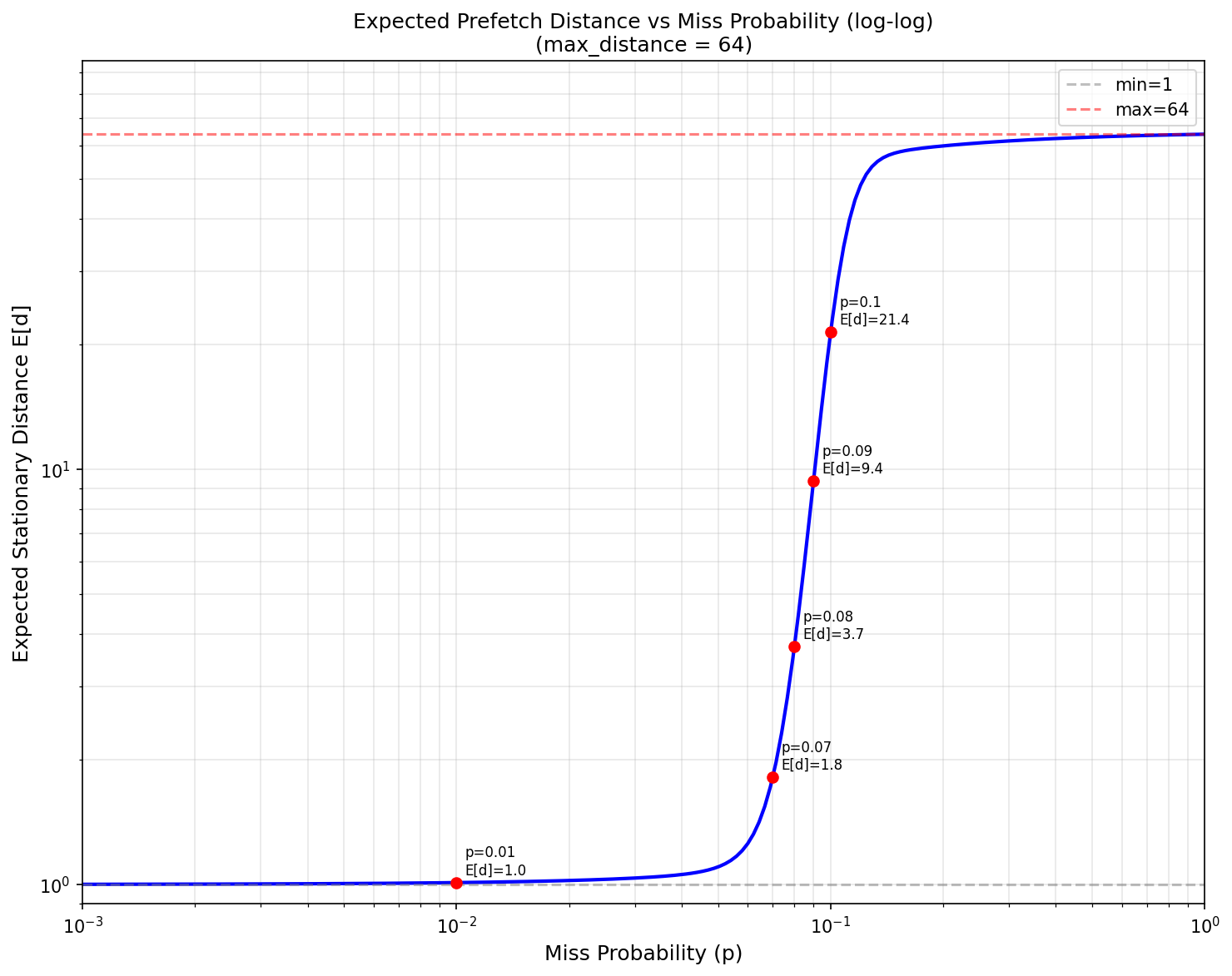
If we assume that the buffers have independent miss probability, we have a markov chain and we can compute the average, I did that and plotted the expected-distances, attached here too. Under this model, the distance should be a straight line so that the number of prefetched buffers stay constant.
There are other ways to look at issued IOs, either using iostat, or
tools like perf-trace.
Noted.
What does "reasonable to prefetch" mean in practice, and how you
determine it at runtime, before initiating the buffer prefetch?
Probably what you already do, set a limit, e.g. don't exceed the maximum number of pinned buffers.
Not at the moment, AFAIK. And for most index-only scans that would not
really work anyway, because those need to produce sorted output.
Yes, return in order, but if we have a long scan, what can be done is to have a buffer of rows. Say the buffers come in the sequence 1,2,4,5,3
process 1, output 1
process 2, output 2
3 not there, process 4
3 not there, process 5
process 3, output 3, 4, 5
If we read rows of 1kB and unpin buffers of 8kB that is memory savings that can be used elsewhere, or if you like prefetch with a higher distance. I imagine you would want this on a separate patch, as this one seems to be very mature already.
Regards,