

Re: Streamify more code paths - Mailing list pgsql-hackers
| From | Xuneng Zhou |
|---|---|
| Subject | Re: Streamify more code paths |
| Date | |
| Msg-id | CABPTF7XFkUM9jm3cvcrr7sPAdmCVVW+PP=GfwUt3N90CeX3u1Q@mail.gmail.com Whole thread |
| In response to | Re: Streamify more code paths (Xuneng Zhou <xunengzhou@gmail.com>) |
| List | pgsql-hackers |
On Wed, Mar 11, 2026 at 11:00 PM Xuneng Zhou <xunengzhou@gmail.com> wrote:
>
> Hi,
>
> On Wed, Mar 11, 2026 at 10:23 AM Xuneng Zhou <xunengzhou@gmail.com> wrote:
> >
> > Hi,
> >
> > On Wed, Mar 11, 2026 at 8:16 AM Andres Freund <andres@anarazel.de> wrote:
> > >
> > > Hi,
> > >
> > > On 2026-03-10 19:27:59 -0400, Andres Freund wrote:
> > > > > > pgstattuple_large          base= 12429.3ms  patch= 11916.8ms   1.04x
> > > > > > (  4.1%)  (reads=206945->12983, io_time=6501.91->32.24ms)
> > > > >
> > > > > > pgstattuple_large          base= 12642.9ms  patch= 11873.5ms   1.06x
> > > > > > (  6.1%)  (reads=206945->12983, io_time=6516.70->143.46ms)
> > > > >
> > > > > Yeah, this looks somewhat strange. The io_time has been reduced
> > > > > significantly, which should also lead to a substantial reduction in
> > > > > runtime.
> > > >
> > > > It's possible that the bottleneck just moved, e.g to the checksum computation,
> > > > if you have data checksums enabled.
> > > >
> > > > It's also worth noting that likely each of the test reps measures
> > > > something different, as likely
> > > >   psql_run "$ROOT" "$PORT" -c "UPDATE heap_test SET data = data || '!' WHERE id % 5 = 0;"
> > > >
> > > > leads to some out-of-page updates.
> > > >
> > > > You're probably better off deleting some of the data in a transaction that is
> > > > then rolled back. That will also unset all-visible, but won't otherwise change
> > > > the layout, no matter how many test iterations you run.
> > > >
> > > >
> > > > I'd also guess that you're seeing a relatively small win because you're
> > > > updating every page. When reading every page from disk, the OS can do
> > > > efficient readahead.  If there are only occasional misses, that does not work.
> > >
> > > I think that last one is a big part - if I use
> > >   BEGIN; DELETE FROM heap_test WHERE id % 500 = 0; ROLLBACK;
> > > (which leaves a lot of
> > >
> > > I see much bigger wins due to the pgstattuple changes.
> > >
> > >                        time buffered          time DIO
> > > w/o read stream        2222.078 ms            2090.239 ms
> > > w   read stream         299.455 ms             155.124 ms
> > >
> > > That's with local storage. io_uring, but numbers with worker are similar.
> > >
> >
> > The results look great and interesting. This looks far better than
> > what I observed in my earlier tests. I’ll run perf for pgstattuple
> > without the switching to see what is keeping the CPU busy.
> >
> > --
> > Best,
> > Xuneng
>
> io_uring
> pgstattuple_large          base=  1090.6ms  patch=   143.3ms   7.61x
> ( 86.9%)  (reads=20049→20049, io_time=1040.80→46.91ms)
>
> I observed a similar magnitude of runtime reduction after switching to
> pg_buffercache_evict_relation() and using BEGIN; DELETE FROM heap_test
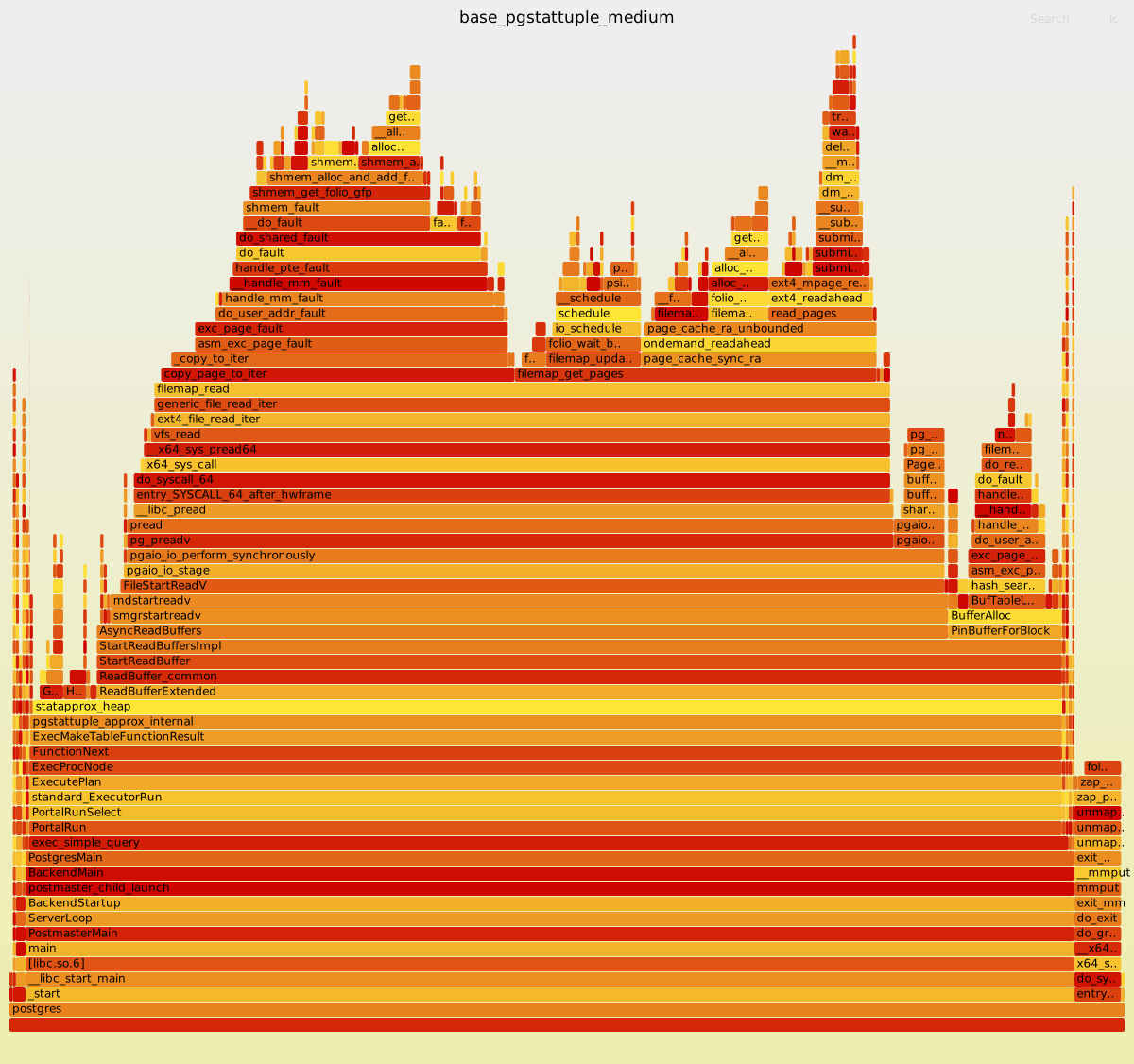
> WHERE id % 500 = 0; ROLLBACK. However, I lost the original flame
> graphs after running many performance tests. I will regenerate them
> and post them later.

In the original setup, UPDATE ... WHERE id % 5 = 0 touches a large
fraction of heap pages. On touched pages, we clears PD_ALL_VISIBLE and
the corresponding visibility-map bit, and UPDATE also creates new
tuple versions, adding tuple-chain/page churn. Since
pgstattuple_approx skips only pages still marked all-visible, it ends
up reading most heap pages. With shared-buffer eviction and OS
page-cache drop before timing, many of those reads are cold misses, so
runtime is spent a lot in the buffer-miss path as seen from the
original flamegraph.

The rollback-delete setup changes this in two ways. First, BEGIN;
DELETE ... WHERE id % 500 = 0; ROLLBACK; still clears all-visible
state on touched pages, but does not leave persistent successor tuple
versions the way UPDATE does. Pages are still modified (tuple
headers/page flags), but physical churn is lower. Second, the
predicate is much sparser, so fewer pages lose all-visible status, and
pgstattuple_approx reads fewer heap pages.

A warmup pass further stabilizes results by setting hint bits for
aborted xmax once up front, so later repetitions avoid repeating part
of transaction-status resolution during visibility checks.

With fewer non-all-visible pages, fewer cold misses, less
eviction/victim churn, we can observe more pronounced speed-up in the
improved version of pgstattuple test.

--
Best,
Xuneng
Attachment

pgsql-hackers by date: